
+974 70433669
[email protected]
facebook
twitter
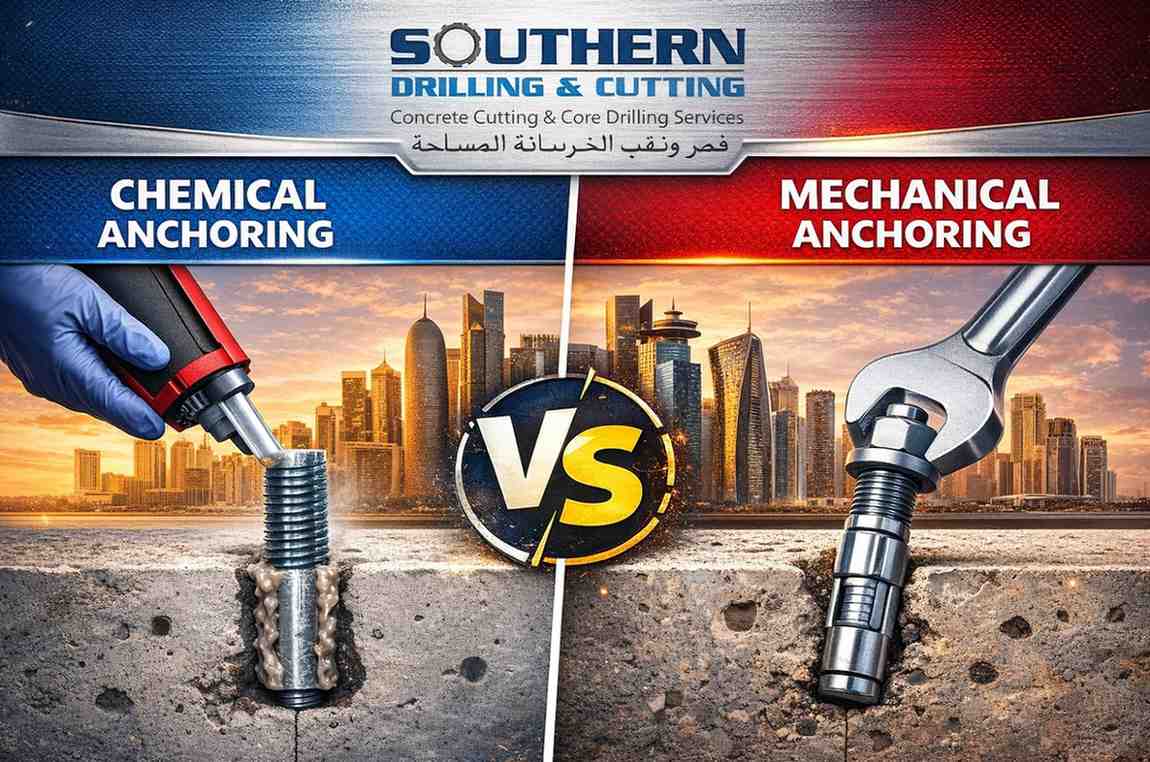
In modern construction, anchoring systems play a critical role in ensuring structural stability, load transfer, and long-term safety. Whether it’s fixing steel structures, installing heavy equipment, or reinforcing concrete elements, choosing the right anchoring method directly impacts performance and durability.
Two of the most widely used systems are chemical anchoring and mechanical anchoring. While both are effective, they serve different purposes depending on project requirements, load conditions, and environmental factors. Understanding the difference between these two methods helps engineers, contractors, and project managers make informed decisions, especially in demanding construction environments like Qatar.
Chemical anchoring is a method of fixing bolts, rebars, or threaded rods into concrete using a chemical adhesive (resin). The adhesive bonds the anchor to the base material, creating a strong and uniform load distribution.
This method is widely used in:
Structural strengthening and retrofitting
Installing heavy machinery
Fixing steel columns and base plates
Rebar connections and extensions
Unlike traditional methods, chemical anchoring does not rely on expansion forces. This makes it ideal for applications where precision and structural integrity are critical.
Mechanical anchoring involves using expansion anchors, wedge anchors, or sleeve anchors that grip the concrete through physical expansion. As the anchor is tightened, it expands inside the drilled hole, creating friction and holding the fixture in place.
Mechanical anchoring is commonly used for:
Light to medium load applications
Temporary installations
Non-structural fixings
Quick fastening requirements
It is often preferred when speed and simplicity are more important than load performance.
Chemical anchors provide higher load-bearing capacity because the adhesive distributes stress evenly across the surface. Mechanical anchors rely on expansion pressure, which can create stress points in the concrete.
Chemical anchoring requires hole cleaning, resin injection, and curing time. Mechanical anchoring involves drilling, inserting the anchor, and tightening. Mechanical anchors are faster, but chemical anchors provide better performance.
Chemical anchoring is non-expansive, meaning it does not put pressure on the surrounding concrete, reducing the risk of cracks. Mechanical anchoring creates expansion forces that may cause micro-cracks.
Chemical anchors allow flexible positioning and variable embedment depth. Mechanical anchors are limited by fixed sizes and installation constraints.
Chemical anchoring performs better in high-load environments, vibrating structures, and aggressive conditions. Mechanical anchors may loosen over time under stress.
Chemical anchoring is the better option when your project requires high load-bearing strength, structural reliability, installation near edges without cracking, and long-term durability. It is widely used in large-scale construction projects across Qatar.
For best results, working with an experienced Chemical Anchoring Contractor in Qatar ensures proper installation and long-term performance.
Mechanical anchoring is suitable when speed of installation is important, loads are moderate, and applications are temporary or non-structural. It is commonly used in basic construction tasks.
Selecting the wrong anchoring method can lead to structural instability, cracks, increased maintenance costs, and safety risks. Proper evaluation is essential before choosing the right system.
Construction in Qatar involves reinforced concrete structures, high temperatures, and demanding load conditions. Chemical anchoring provides strong bonding without damaging the base material, making it ideal for commercial, industrial, and infrastructure projects.
Many contractors rely on professional Chemical Anchoring Contractor in Qatar services to ensure quality and compliance.
Anchoring requires correct hole size, proper cleaning, accurate resin application, and controlled curing time. Any mistake can compromise the structure.
Southern Drilling & Cutting delivers reliable anchoring solutions with experienced technicians and advanced equipment. As a trusted drilling contractor in Qatar, the company supports projects with core drilling, cutting, and anchoring services.
Both chemical and mechanical anchoring have their place in construction. Chemical anchoring is best for strength and durability, while mechanical anchoring is suitable for speed and lighter applications. Choosing the right method ensures safety, performance, and long-term reliability.